
When “Winning” the Redline Loses the Deal
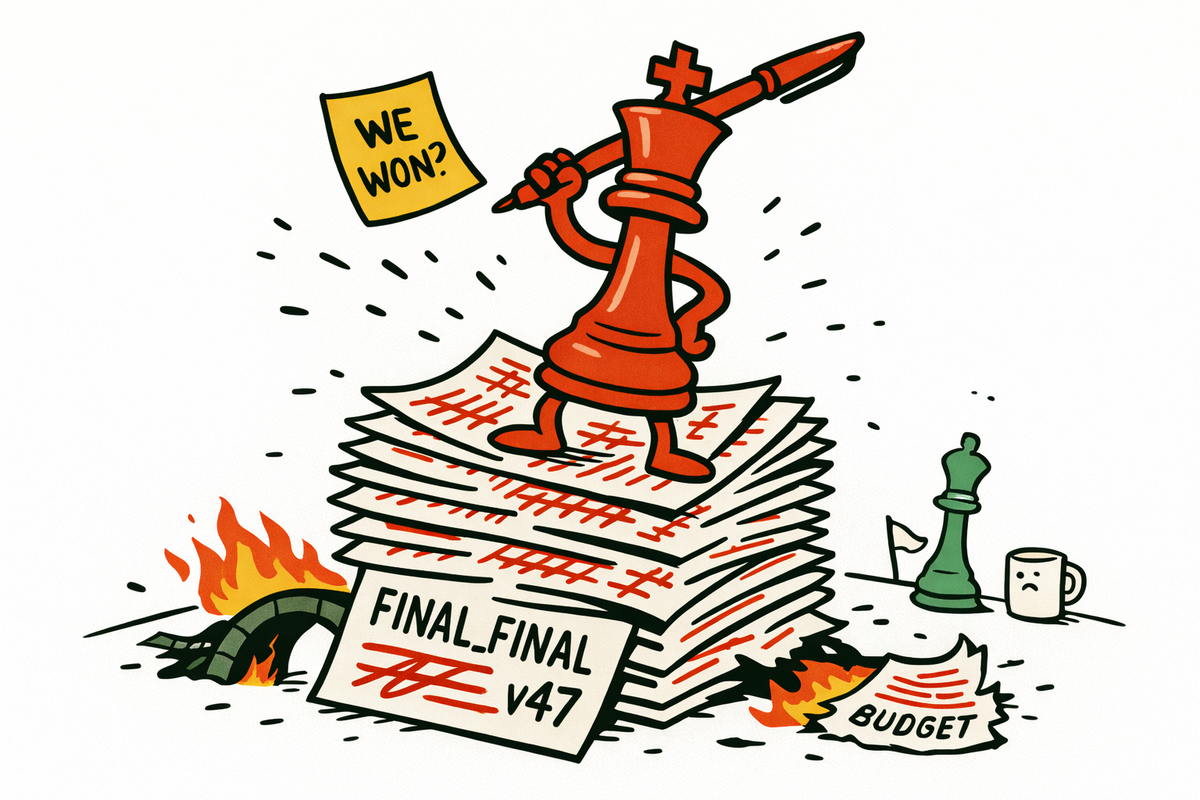
Some lawyers treat negotiation like war. They rack up redlines like trophies. But “winning” the markup can still lose the deal — or torch the budget. A flashback story from Biglaw that explains why.
Redliner’s Log – Entry 2.5
Stardate: January 13, 2026
Location: Flashback Subroutine Engaged. Pre-cloud, Pre-GenAI. Ancient WordPerfect Airspace.
So, we’re almost there. But before we change gears, let me tell you a story.
I was a young associate at a large, international law firm, still trying to find my rhythm, when I got staffed on a big deal. High stakes. Lots of zeroes. Lots of eyes. One of those “don’t screw this up” assignments.
Leading the charge was a senior partner—super well-known in the circles. Brilliant guy. Deep experience. Giant book of business. Total (and I mean total) command of the contract. Also? Loved to fight.
His approach was simple: if the other side didn’t cave on the majority of our markup—and we were going to modify every deal to match our gigantic, leveraged master form—we’d “lost.” We were to take the hard line. Move the other side’s position. Argue. Then argue some more. It was about control. About dominance. About making the paper reflect his superior intellect.
I took a swing at responding to the agreement we’d been provided. Back then, we were printing things out, scribbling in our notes and changes, and having our admins incorporate the changes into the Word doc. I worked the document, had multiple back-and-forths with the partner, and finally created a turn of the agreement to send to the other side. But first, it had to go to our client for their input and approval.
The markup looked like a crime scene. Red ink everywhere. Entire clauses DOA. Numbering and formatting reengineered because, quote, “it wasn’t proper structure.”
The client agreed with the changes. In so doing, they told us something I found (and still find, after all these years) amazing. The business folks on the other side had made an offer.
When they had learned that this partner was representing our client, they offered our client a huge discount if our client would agree to use literally anyone else as their lawyer.
They didn’t care who. Just not him.
Why? Because they’d dealt with him before on other deals. They knew he was going to make this as inefficient a process as could be imagined. They’d seen him crater transactions and over-leverage contracts because “he could.” It was worth cold, hard cash to them to avoid the waste of time, effort, and energy they foresaw coming.
The partner thought it was a compliment. He actually smiled.
I wanted to scream.
Unfortunately, our client thought it was great, too. Somehow, it stroked their ego as well. Then, after grinding out a deal over the course of several months that should have been measured in weeks, they got the bill. And they didn’t get much of a kick out of that. He hadn’t killed the deal—this time. But he did kill the budget.
The Fallacy of “Winning” the Redline
There’s a certain breed of deal lawyer (and we’ve all seen them) who thinks negotiation is a zero-sum game. That every deleted word is a victory. That their job is to “win” the markup.
Let me say this plainly: There’s no trophy for the most redlines. No leaderboard. No bonus points.
Clients don’t throw parades for lawyers who “dominate” the other side. They just want the deal done... on reasonable terms, without unnecessary carnage.
A contract is a partnership—it’s two parties trying to do business… together.
A scorched-earth markup doesn’t make you look smart. It makes you look insecure. Or worse: replaceable.
Redlines Are a Tool, Not a Scorecard
The purpose of the markup is to move the deal forward. To align on expectations. To create mutual clarity and trust.
If your redline is designed to show off, slow down, or sneak in traps? You’re not helping. You’re flexing.
And eventually, people notice.
Your client notices. The other side definitely notices. And the deal—if it closes at all —drags along a trail of resentment and wasted time.
This Is the Culture We’re Trying to Undo
The legal world is filled with these ghosts. People who think the game is about “winning the redline” rather than getting to “yes.”
Unfortunately, the current solutions out there (including GenAI) don’t fix this. They may make things move faster. But there are also folks who argue that they arm people like the partner in my anecdote to do even more damage.
Either way, we still face this problem.
At Transactency, we’re not here to shame the past. Hell… some of us were the past.
But we are here to build a different culture. One where negotiations are measured by usefulness, not volume. Where the goal isn’t to “win the redline”… it’s to close the deal with clarity, speed, and trust intact.
Back soon with Entry 3.1, where we start unpacking how a shared playbook can stop the madness before it starts.
Until then, may your markups be light… and your lawyers self-aware.
Weigh in
What’s the most ridiculous “redline win” you’ve ever seen… that ultimately cost the deal (or the budget)?
Join the discussion on LinkedIn
Want to stop redline theater before it starts?
Transactency is building the shared-playbook way to negotiate contracts faster… without the chaos. Join the beta on the site!