
When Deals Start in Alignment Instead of Suspicion
Most negotiations don’t break during redlines. They break the moment the first draft lands. What if the process started with shared terrain instead of suspicion?
Redliner’s Log – Entry 3.4
Stardate: February 12, 2026
Location: Final Approach
We’ve named the chaos. We’ve exposed the repetition. We’ve seen how the same human patterns show up inside the clauses.
Now here’s the real question: what changes when the deal doesn’t start with suspicion?
Because that’s the part we’ve all quietly accepted as normal. And that’s a friggin’ shame.
In the traditional world, the very first thing one side does is send “their paper.” It’s typically a draft that feels like a position disguised as a document. And the other side’s job is to defend themselves.
Trust doesn’t erode during redlines.
It erodes the moment that first draft lands in your inbox.
Shoulders tighten. Tone shifts. People start reading for traps, not understanding.
Because the structure of the process assumes we’re opponents.
Your paper. My paper. Hidden leverage. Strategic ambiguity.
That’s the starting gun.
Now imagine a different opening move
Imagine this: instead of sending “our paper,” you invite the other side to review a structured agreement built on a shared playbook—one that makes the decision zones visible. The flex areas surfaced. The common paths clear.
You’re not hiding your position inside paragraphs.
You’re showing your cards in the structure of the draft itself.
Before anyone reviews it. Before any edits start. Before a single redline exists.
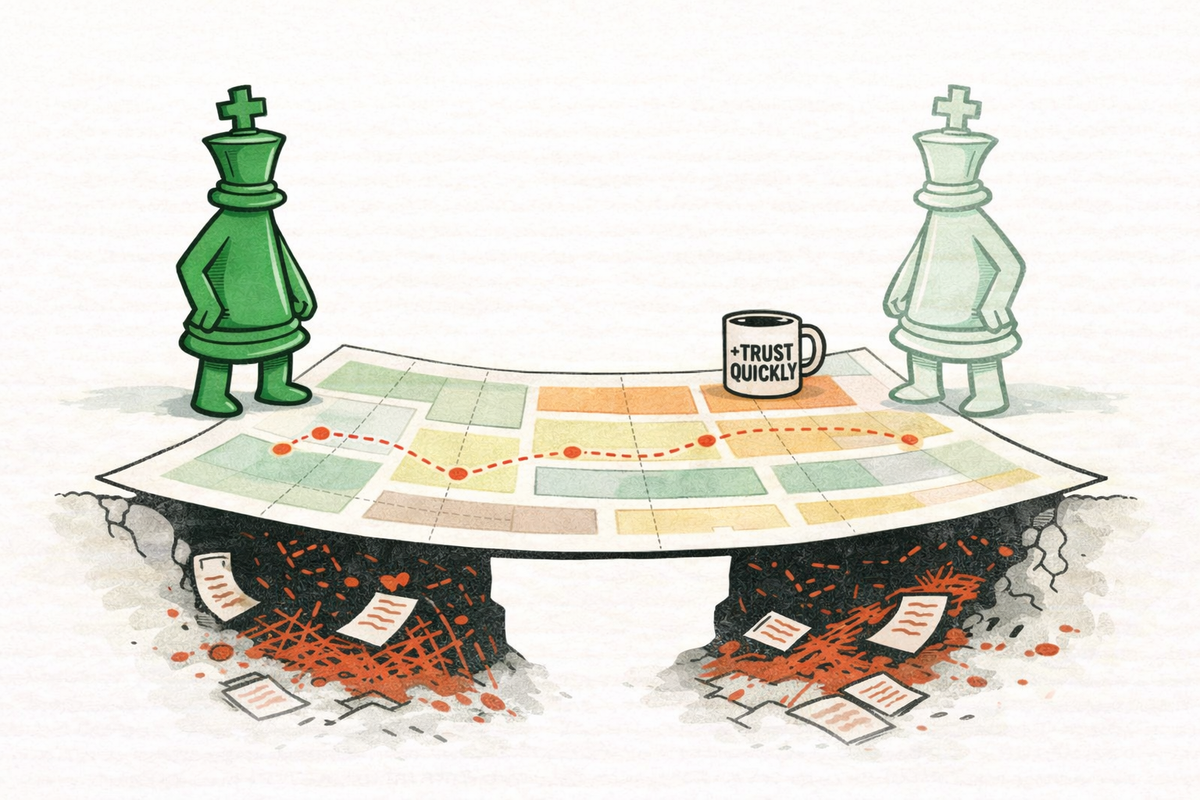
The draft isn’t a move in a chess match.
It’s a signal.
A signal that says: we’re not trying to win by obscurity. We’re here to make decisions in the open.
Before a single edit happens, the tone is different.
The other side doesn’t feel like they’ve been handed a weapon. They feel like they’ve been handed a map.
What actually changes
Legal doesn’t enter the process as the brake pedal. Sales doesn’t lose credibility the moment “the contract” shows up. Business teams don’t throw deals over the wall and wait in the dark.
You don’t spend energy proving you’re tough.
You spend it deciding what matters.
The friction moves from syntax to substance. From ego to economics. From performance to problem-solving.
You still negotiate. Hard. If you have leverage and want to use it, go for it.
But you’re negotiating on the same terrain.
And that changes behavior.
People concede faster when they understand the landscape. Trust builds when motivations are visible. Momentum survives.
I'll admit, some people like the old dance.
They like obscurity. They like leverage through complexity. They like being the only one who “really understands the paper.”
I know this. I’ve met with them. And I hate to admit it... at times, I've been them.
Guess what? We’re not building for them.
Because those deals don’t age well. They crack under stress. They turn into disputes nobody wanted. And that's not what we're about at Transactency.
Fin
I’ve spent this series saying out loud what most people only complain about privately.
Now comes the part that matters.
Over the next few weeks, this stops being a thought experiment.
Real people. Real negotiations. Inside a structure designed to start with alignment instead of suspicion.
We’re about to see what happens when the dance floor changes.
If you’ve ever walked away from a deal thinking, “That was way harder than it needed to be…”
This is where the experiment begins.
Redliner’s Log… signing off. For now.
Ready to #TrustQuickly? Come on in. The water’s warm. We’re inviting a small group to pressure-test this in live deals and you can get in line here.
/M
P.S. - join the discussion on LinkedIn!