
What Actually Happens in Contracting (or: Why Your Deal's Not Done Yet)
Ever watched urgency collide with armor? That’s the modern deal table.
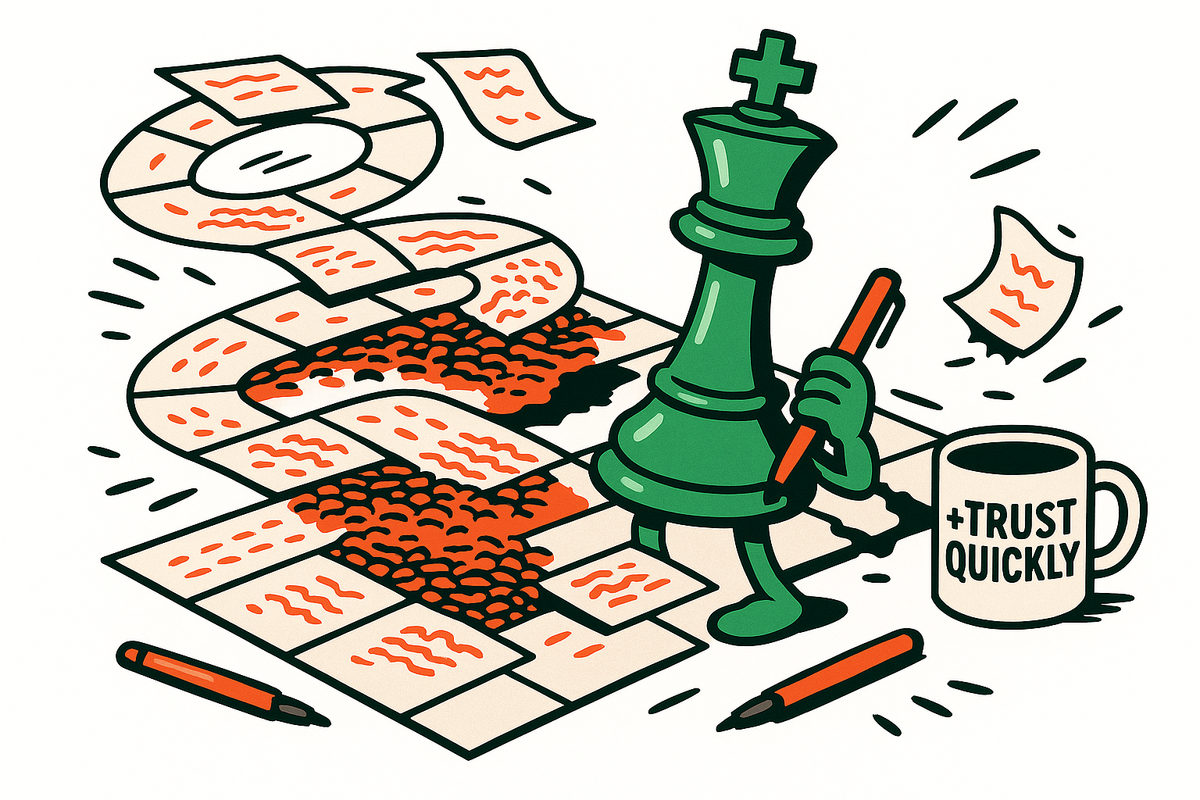
Redliner’s Log – Entry 2.2
Stardate: December 9, 2025
Location: Entering the Contracting Gameboard. Expect delays at Indemnity Junction and Limitation Loop.
You’ve seen it. A sales team swears the deal is done... “we just needs legal sign-off.” A business owner forwards a PDF at midnight with a hopeful, “Can you just bless this real quick?” Or the in-house attorney is handed a fully baked agreement… after the price is already locked, timelines committed, and half the deliverables promised.
And then things slow to a crawl. Redlines. Confusion. Frustration. “What’s legal’s problem?” And before you know it, that “done deal” becomes another ghost in the pipeline.
Why? Because nobody understands the gameboard.
Contracting Isn’t a Blank Page. It’s a Gameboard
Contrary to how it feels, contracting isn’t improvisational jazz. It’s a board game—with recurring players, predictable moves, and well-worn traps.
But most people (especially business folks without legal backgrounds) don’t realize this. They think every contract is a new battle. A fresh negotiation. A bespoke performance.
It’s not.
Whether it’s an MSA, an executive employment agreement, or a prenup, the underlying structure is familiar. We’re just not naming it. Which is why most people wander in unarmed.
Let’s Break Down the Players
The Solo In-House Counsel
Overworked. Under-resourced. Often looped in way too late. They’re expected to be deal doctor, risk sponge, and PR scapegoat... all while moving fast and saying yes. They know the hotspots. But without structure, they’re stuck arguing the same points over and over… or forced to roll over just to keep things moving.
The SMB Owner or Operator
No legal team. Outside counsel is $500/hour—and that’s for the junior associate. They either:
- Avoid legal altogether and hope nothing blows up;
- Google/ChatGPT their way through a redline; or
- Hire help too late—usually once a dispute or bottleneck shows up
In both cases, the result is the same: nobody’s playing the game strategically.
Because nobody knows where the pieces are.
Where We Actually Get Stuck
Despite all the posturing, most contracts don’t fall apart because of major disagreements. They fall apart because people are solving the wrong problems. Or solving the right problems in the wrong order.
Let’s map the terrain of some common clauses you might see, for example, in a commercial agreement:
- Limitation of Liability: “You break it, you buy it.” But how much? And for how long? Or is there even a limit at all?
- Indemnification: The contractual version of “you screwed up and you’re going to make me whole.”
- Termination Rights: What happens when the honeymoon ends?
- IP Ownership: “Who owns the work product?” should not take four rounds to figure out.
- Payment Terms: Cash flow matters. So do penalties, withholdings, and invoicing cycles.
These zones come up again and again in commercial contracts. Very, very frequently.
They’re some of the flex zones in commercial deals from our chili analogy in Entry 1.4. They’re not random; they’re inevitable. And if you’re not ready for them, you lose time, leverage, and momentum.
The Real Problem Isn’t the Clause. It’s the Misalignment.
Let’s take a typical example: a sales rep promises a 30-day implementation. The agreement, once reviewed, has a 90-day payment holdback clause. Legal redlines the hell out of it, because the implementation risk is too high.
Now Sales is frustrated, Legal feels like the bad guy, and the customer is stuck waiting while the internal teams bicker.
This isn’t a drafting issue. It’s a failure of shared visibility and shared assumptions.
And the Tools We Have? Not Helping.
Contract platforms aren’t built to teach contracting. They’re built to store documents, track versions, or (maybe) automate templates.
They don’t show:
- What the typical fallbacks are;
- Why Legal flagged a term; or
- Where the deal risks actually lie
So everyone keeps doing the same thing: marking up, emailing around, making assumptions, and hoping for the best.
That’s not negotiation. That’s Groundhog Day... with redlines.
Teaching Point: Contracting Is a System. But We’re Acting Like It’s Ad Hoc.
Everyone is operating off gut feel and tribal knowledge. There’s no shared playbook. No visual gameboard.
But that doesn’t mean the game doesn’t exist. It just means most of us are losing it without realizing why.
Here’s What Needs to Change
- Acknowledge the Gameboard. Most deals get stuck in the same places. Map those places out. Expect them.
- Loop in Legal Early. Not just to flag problems, but to avoid them before they start.
- Give SMBs Tools, Not Just Templates. Most SMBs aren’t trying to avoid risk, they’re trying to avoid cost. Give them structure and process, not boilerplate.
- Align Before You Redline. Contracts shouldn’t be the first place you discover a misalignment with the other party on scope, ownership, or risk.
Wrapping it up
The chaos isn’t random. And when you know where the fire starts, you can stop fanning the flames.
Weigh in
What's your take on this? I'd love to hear your thoughts.
Join the discussion on LinkedIn
Transactency launches Q1 2026. Want in?
Apply for Beta Here