
The Four Types of Redlines
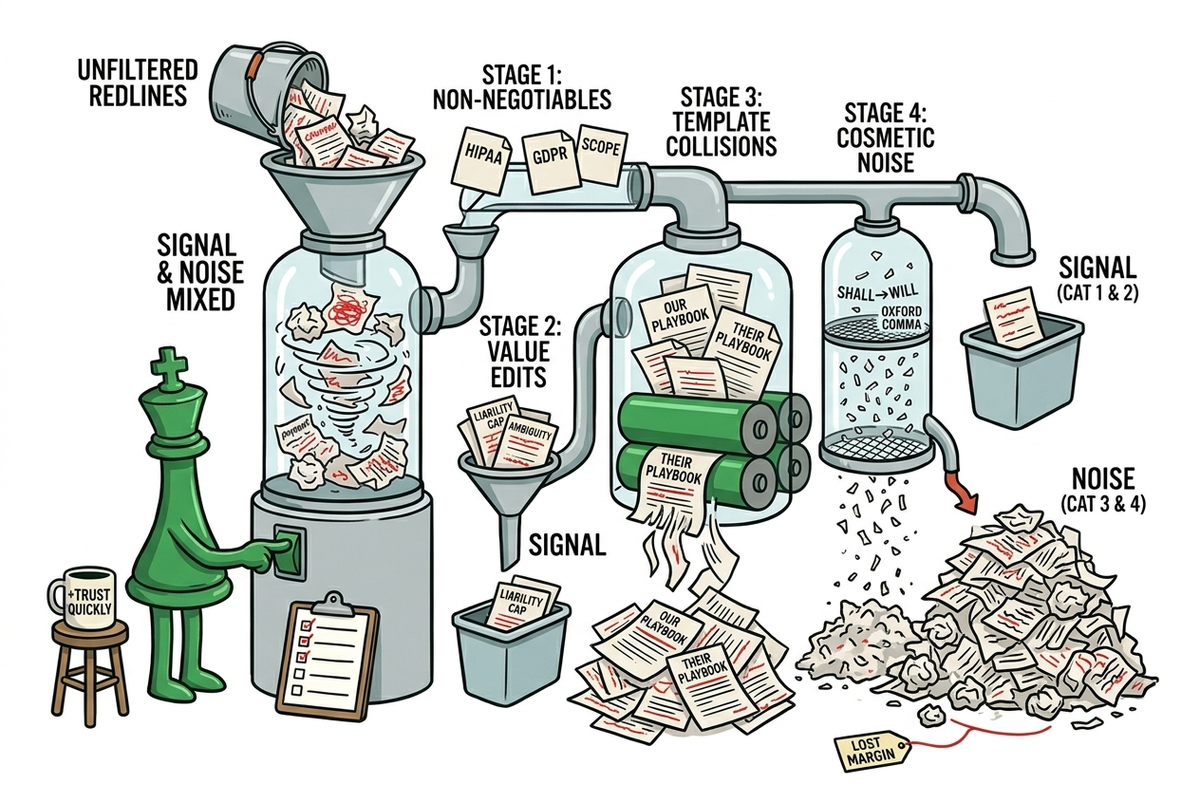
Not all redlines are created equal. In practice, most fall into four categories—from real legal requirements to pure cosmetic edits—and understanding the difference can dramatically change how deals move.
March 19, 2026
A couple of weeks ago, we ran the math.
Fourteen rounds on a mid-six-figure SaaS deal.
Outside counsel fees on their side pushing well into five figures. Internal legal time on ours that nobody actually tracks.
Sales momentum slowed. The relationship strained. Everyone involved convinced they were simply doing their job.
But after walking through that example, a fair question naturally follows:
How does this actually happen?
Because most lawyers involved in those negotiations weren’t reckless.
They were being careful. Thoughtful. Professional.
Yet the process still produced enormous friction.
After about thirty years of practicing law, I’ve come to believe the explanation is surprisingly simple.
Contract negotiations rarely distinguish between the redlines that matter… and the ones that simply create motion.
A comma tweak travels through the same process as a liability clause. A stylistic preference consumes the same oxygen as a regulatory requirement.
Signal and noise move through the same pipe.
So at some point, I started doing something simple during my own reviews.
Before I change anything in a contract, I mentally sort the issue into one of four categories.
This isn’t a formal doctrine. Just a filter developed after a few thousand negotiations.
More importantly, it’s a way I police my own instincts when reviewing agreements.
Because lawyers are very good at improving documents.
Sometimes a little too good.
Category 1 — The Must-Have
These are non-negotiable.
Not because a lawyer prefers them.
Because something with authority behind them requires them.
Sometimes that authority is law.
If a company handles protected health information, HIPAA obligations must appear somewhere in the agreement.
If customer data crosses European borders, GDPR responsibilities have to be addressed.
Those aren’t drafting preferences.
They’re regulatory requirements.
Sometimes the authority is how the product actually works.
Take a commercial SaaS agreement.
If the license clause doesn’t properly grant the customer the right to use the software, the contract isn’t actually doing its job.
The agreement has to describe what the customer is allowed to do.
Otherwise, the entire structure collapses.
And sometimes the authority comes from inside the company.
Boards may approve risk tolerance. Management may set policies.
A company may refuse unlimited liability because of its size. Or decline to indemnify a customer for the customer’s own misuse of the product.
Those positions aren’t meant to be improvised mid-negotiation.
Category One redlines enforce those boundaries.
They deserve oxygen.
And fortunately, there aren’t many of them.
Or at least there shouldn’t be.
Category 2 — Where Legal Actually Adds Value
This is the work experienced counsel are supposed to do.
Not rewriting the contract for sport.
Modifying it where it matters.
Category Two issues require judgment… and, typically, experience.
A clause might technically work but expose the company to more risk than the deal justifies.
A sentence might technically say something but do so in a way that creates ambiguity if a dispute ever lands in court.
Sometimes language simply doesn’t align with the company’s broader strategy.
That’s where experience shows up.
In commercial deals, that might mean adjusting liability caps to match the economics of the deal.
Clarifying language that could produce competing interpretations later.
Expanding a clause that’s written too vaguely to guide real behavior.
There are also provisions that tend to be modified deal-to-deal because of real negotiation leverage… indemnities, liability caps, service levels.
Seasoned lawyers know these areas are commonly negotiated and understand where the market usually lands.
When I’m looking at issues in this category, I try to ask myself a simple question:
If I make this change, is it worth my time (and my client’s money) to do so?
Could I explain to the client why the issue matters?
Could I justify the legal spend required to push it?
Because every redline carries a cost.
Another round. Another review. Another conversation.
Category Two edits are the ones where that cost is justified.
This is where legal actually adds value.
Category 3 — The Template Collision
This is where negotiations usually start drifting.
Category Three edits often happen when two templates or playbooks collide.
One party has its preferred form, clauses, or positions. The other party has theirs.
And suddenly large portions of the document get rewritten… not because the meaning is wrong, but because the wording is different.
A party changes language because their template phrases it another way.
A newer attorney redlines provisions that rarely move in real deals but doesn’t yet have the experience to know that.
Someone applies a playbook without considering the commercial and economic context of the agreement.
In many cases, if a dispute ever reached a courtroom, the original clause and the revised clause would likely be interpreted the same way.
Or the potential increase in liability—one way or the other—would be minuscule.
But the markup process doesn’t care.
Once the redline appears, it demands a response.
And another round begins.
Momentum slows.
Not because anyone is protecting the company.
Because playbooks and templates are colliding.
Category 4 — The Pure Oxygen Burn
Then there’s the final category.
The one that quietly drives everyone insane.
Pure cosmetic edits.
“Shall” becomes “will.” “Promptly” becomes “without undue delay.” Paragraphs get reorganized.
Someone insists on removing the Oxford comma. Someone else insists on keeping it.
For the record, I’m vehemently pro-Oxford-comma.
But even I know that’s not the hill to die on in a contract negotiation.
These changes don’t affect how a judge would interpret the agreement. They don’t affect how the parties behave.
But they still trigger a full markup cycle.
Automation tools frequently amplify this problem (they do this in Category 3, too).
Run an agreement through a contract review system and suddenly half the document gets rewritten in the name of “consistency.”
And none of the changes are economically or legally meaningful.
Category Four edits consume oxygen without improving the deal.
Where Momentum Starts Disappearing
If negotiations contained only Category One and Category Two edits, most deals would move quickly.
Real issues would surface. Real decisions would get made.
But Categories Three and Four introduce something different.
Drag.
They create additional rounds that don’t meaningfully change the outcome.
Sales cycles stretch.
Internal teams spend time reviewing edits that don’t alter risk.
Relationships between the parties start to fray.
And everyone involved believes they’re simply doing thorough work.
The Discipline I Try to Apply
Over time, I’ve tried to discipline my own reviews using this framework.
Category One gets immediate attention.
Category Two gets thoughtful negotiation.
Categories Three and Four require restraint.
Just because I can improve a sentence doesn’t mean I should.
Just because a clause differs from my template or clause book doesn’t mean it needs rewriting.
And just because something I do is technically better drafting doesn’t mean the deal benefits from another round of markup.
Contracts exist to support transactions.
Not to become writing competitions.
Wrapping It Up
Redlines aren’t the problem.
Unfiltered redlines are.
Some protect the company. Some improve the agreement.
Many simply burn oxygen.
After thirty years of watching deals slow down for reasons nobody could quite explain, this four-category filter has become the simplest way I know to keep negotiations moving.
Next week I’ll focus on the structural side of the problem.
Because templates aren’t laziness.
They’re discipline.
And companies that standardize intelligently tend to close deals much faster than the ones that treat every agreement like a blank page.
Comment on LinkedIn.