
One Clause. Your Whole Negotiation Personality.
Contract clauses aren't just legal mumbo jumbo. They can be tells. How someone negotiates a single clause reveals how they think about risk, momentum, leverage, and accountability.
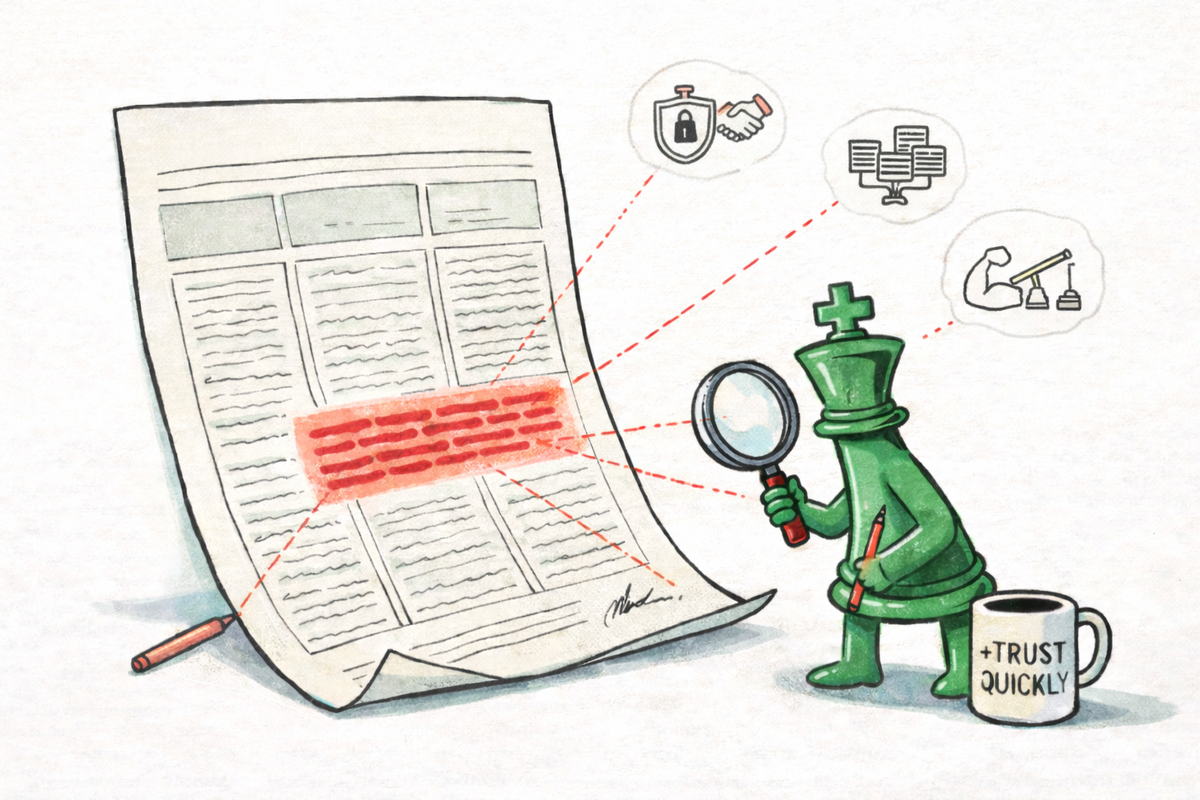
Redliner’s Log – Entry 3.3
Stardate: February 3, 2026
Location: Clause Lab in Outer Nebula
We’ve been talking about repetition. About how the same fights keep showing up in different contracts.
So let’s zoom in.
Not on a deal. On a single clause. Limitation of Liability.
Of course.
Almost every commercial agreement has it. Every lawyer rewrites it. Every negotiation slows down when this one comes up.
But here’s what’s actually happening…
This clause isn’t just allocating risk.
It’s revealing how each side sees the world.
What This Clause Is Supposed to Do
On paper, it’s simple: if things go sideways, how much can each side lose?
Cap the dollars. Exclude certain damages. Carve out special scenarios.
Clean. Logical. Contained.
In theory.
What This Clause Reveals
In practice? It turns into a diagnostic tool.
Because there are really only a handful of structural positions that are typically taken by the parties:
Low cap, tight (or no) exclusions;
Moderate cap, perhaps with specials, with targeted carveouts;
Higher cap with broader exceptions; and
Very high or effectively uncapped in certain areas.
Same menu. Different wording.
But the way someone pushes on this clause tells you everything about how they operate.
The Over-Protector
This negotiator wants the lowest cap possible. No exclusions. Minimal carveouts.
Not because they’ve modeled the risk in detail.
Because their job, in their mind, is to eliminate downside at all costs. Even if the deal becomes commercially strained.
They are not negotiating the deal. They are negotiating their own exposure to blame.
The Deal-Momentum Optimizer
This one pushes for something reasonable, early.
Not because they don’t care about risk.
Because they understand delay has a cost. Lost momentum is a cost. Relationship friction is a cost. Sales matter.
They’re managing the whole equation, not just the legal variable.
Their question isn’t just “What’s the exposure?” It’s “What’s the exposure versus the value of getting this done?”
The Scale Player
Large, well-capitalized companies often push for higher caps and broader carveouts. From the other side, this can feel disconnected from the economics of the deal.
But the driver isn’t posturing.
It’s scale.
Risk doesn’t grow in a straight line for big companies. It compounds.
More customers. More data. More regulators. More publicity. More class-action exposure.
So when something breaks—a data breach, service failure, system outage—the downstream consequences multiply. The same incident that might be manageable for a small company can cascade into a multi-million-dollar problem at enterprise scale.
From their perspective, a cap tied to contract value often misses the point.
Contract value ≠ exposure.
The vendor is looking at the value of the deal. The enterprise is looking at the size of the blast radius.
Same clause. Two different risk models.
The Leverage Compensator
Weak commercial leverage. Strong legal posture.
They know they can’t win on price, scope, or commercial terms… so the fight moves to the contract.
The clause becomes a place to claw back control.
If they can’t shape the business deal, they shape the risk envelope.
What This Tells Us
Same clause. Same few structural options.
Wildly different motivations.
Most of the friction isn’t about the clause.
It’s about what the clause represents.
Risk tolerance. Internal accountability. Deal urgency. Organizational scale. Power dynamics.
But because the clause is buried in prose… we argue language instead of naming what’s actually happening.
We fight commas while the real variables stay invisible. And invisible problems turn into emotional fights.
A real playbook makes the landscape visible. It acknowledges that one size doesn’t fit all.
It surfaces the typical structural positions. It informs what each one protects. It advises when each usually makes sense. And it divulges what operational or economic reality usually drives it.
Suddenly, the conversation shifts from “Your language is unacceptable” to “We’re comfortable with X risk, not Y. Where can we meet?”
And once you see this pattern in one clause, you start seeing it everywhere.
Indemnities. Reps and warranties. Termination rights.
Same menu. Same drivers. Same dance.
But the real shift doesn’t happen inside the clause.
It happens before the negotiation even starts.
Join the discussion on LinkedIn
Want to stop redline theater before it starts?
Transactency is building the shared-playbook way to negotiate contracts faster… without the chaos. Join the beta on the site!
,