
Ego with a JD— Or, We Redline to Look Smart
The contract isn’t always the problem. The psychology is. This is the toll no timesheet captures.
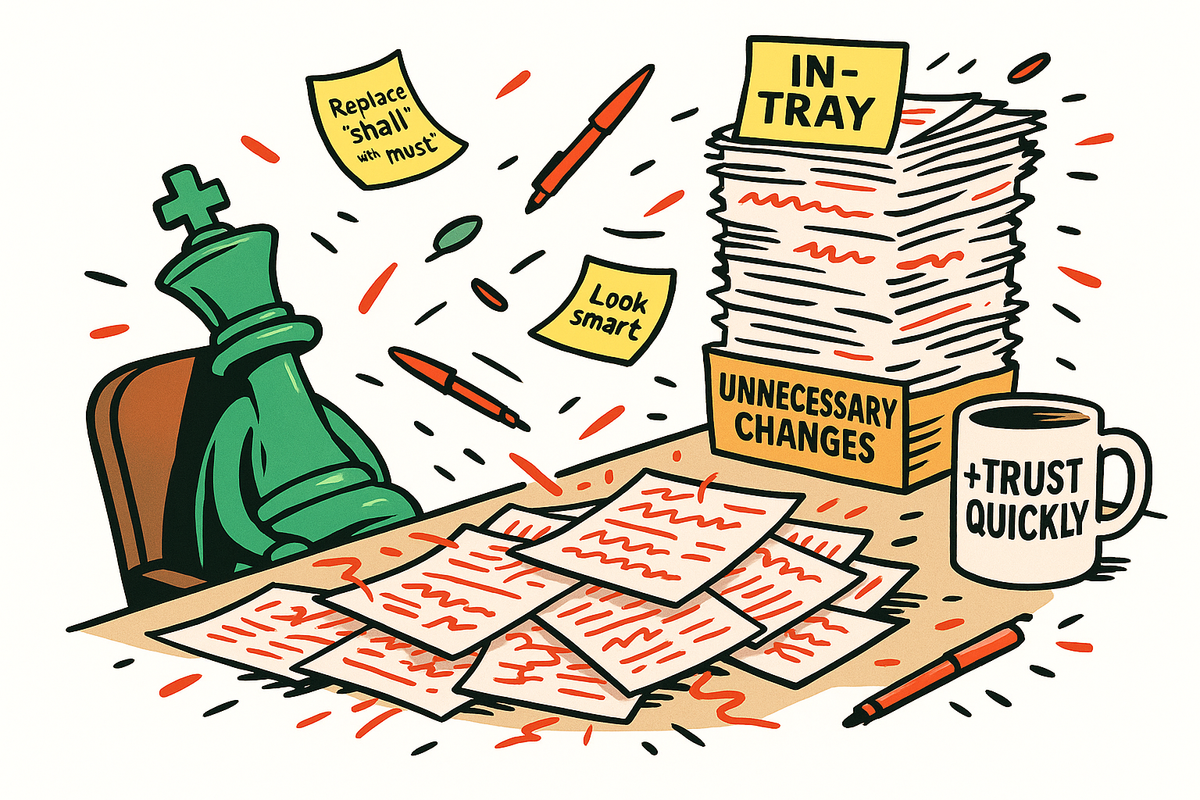
Redliner’s Log – Entry 1.2
Stardate: November 11, 2025
Location: Still stuck in orbit around Legal Review Planet. No signs of intelligent markup.
We talk a lot about risk in contracts. Risk mitigation. Risk allocation. Risk transfer.
But let’s be honest: half the time, it’s not about risk. It’s about reputation.
“If I don’t redline this, they’ll think I missed it.” “If I push back, I’ll look smart.” “If I don’t, I’ll look soft.”
And so the pen gets picked up. Not to clarify. Not to protect. But to perform.
We’ve all seen it—the hyperactive markup from the junior associate trying to impress a partner. The overly aggressive in-house counsel trying to “earn their seat at the table.” The vendor-side lawyer who knows this clause won’t survive, but marks it anyway to keep the power dynamic in check.
I’ve been that person. And I’ve worked with dozens of them.
It’s ego. With a law degree. And a red pen.
You Redline, Therefore You Are
In some corners of the legal world, if you’re not redlining, you’re not adding value.
Silence is risky. Acceptance is weak. So we perform.
Even if the clause is fine. Even if the risk is theoretical. Even if the change slows the deal to a crawl.
I once had a co-counsel who wouldn’t let anything go untouched. If a clause had the word "expeditiously," he'd change it to "without undue delay." If it said “shall,” he’d make it “must.” He was, in his words, “maintaining leverage.” In mine? He was bleeding momentum.
Okay, I'm exaggerating a bit here, but you get the point.
It didn’t matter what side he was on. Buyer, seller, licensor, licensee… didn’t matter. He needed to be seen doing something. To justify the retainer. To "win" the internal meeting. To “protect the company.”
But in reality? He was protecting his image.
The Hidden Cost of Legal Theater
Here’s the part that rarely gets discussed: redlining for ego isn’t just annoying; it’s destructive.
It erodes trust before a relationship even begins. It creates adversarial energy in deals that should be collaborative. It wastes time, burns budget, and often forces the businesspeople to clean up the mess.
I’ve watched what should’ve been a one-week contract turn into a four-week slog because a single attorney refused to back off on some issues that didn’t even apply to the deal at hand.
The irony? He didn’t even understand the business model. He just didn’t want to look like he’d “missed something.”
So we circled. And postured. And eventually closed… weeks late and emotionally drained.
When the Playing Field Tilts
Sometimes, uneven power dynamics aren’t about size. They’re about experience.
Years ago, I worked on an M&A deal where the opposing counsel wasn’t an M&A lawyer. He was a generalist—solid guy, smart guy—but his background was mostly residential real estate closings. This wasn’t his terrain.
Now, here’s the kicker: we knew each other. Well. He’d actually coached my soccer team when I was a kid. Small world.
But that familiarity didn’t help. In fact, it probably made it worse.
He didn’t want to look like he was in over his head in front of his client—particularly to a "kid he used to coach."
So he postured. Hard. Redlined aggressively. Took stances that didn’t make sense. Dug in where there was no need.
I don’t think he meant to derail the deal. But the result? A slow, frustrating, ego-fueled slog. Every step was harder than it needed to be… not because of substance, but because of perception.
That’s the danger of the uneven playing field. Not just imbalance, but insecurity masquerading as strength.
Legal as Proxy Warrior
Sometimes, this redline dance isn’t just about ego; it’s about businesspeople outsourcing confrontation.
Rather than say, “We’re not comfortable with this,” they hand it to legal.
“You be the bad guy.” “You make them sweat.” “You send the message.”
And legal obliges.
They fire off dense markups, sprinkle in a few “non-standard” notes, and the relationship shifts.
Now it’s not two teams trying to do a deal. It’s two firms fighting over turf. In Microsoft Word.
When legal becomes the weapon, the deal stops being the goal. Winning does.
And Still… We Keep Doing It
Even now, with all the tech, templates, and shared forms in the world, we’re still stuck in the theater.
Because it’s not a tooling problem. It’s a culture problem.
We’re still rewarding the performative lawyer. Still valuing the “strong markup” more than the clean close. Still confusing caution with competence.
It’s no wonder contracts have become slower, costlier, and more painful to negotiate. We’ve prioritized posture over progress.
Wrapping it up
This diary isn’t about blaming lawyers. It’s about naming a behavior we’ve all witnessed… and, if we’re honest, participated in.
The legal world isn’t full of bad actors. But it is full of incentives that make smart people do counterproductive things.
I’ve done them. I’ve watched them. And now I’m ready to stop.
We don’t need less legal. We need less performance.
Weigh in
What's your take on this? I'd love to hear your thoughts.
Join the discussion on LinkedIn
Transactency launches Q1 2026. Want in?
Apply for Beta Here