
Clauses, Chili, and Chaos: Understanding the Real Structure of a Contract
Deals start with hope. Redlines smother it. This is where trust dies… quietly, in tracked changes.
Redliner’s Log – Entry 1.4
Stardate: November 25, 2025
Location: Entering Sector 7: Clause Nebula. Instruments picking up mild turbulence around Limitation on Liability.
Let’s talk chili. Because I love me some good chili. I know, I know—turkey is coming in a couple of days... but work with me here.
Hopefully, you’ve seen some cooking shows (Iron Chef could easily merit an entire diary entry of its own here 😁). Having watched them, you’d know that, among other things, they usually contain some type of massive, stainless-steel, dream pantry filled with every spice, protein, and obscure root vegetable known to man.
We’re talking freaking ridiculous. In a great, great way. And the pans... don't get me going on all of the pans they get to use....
Focus, Denker. Focus...
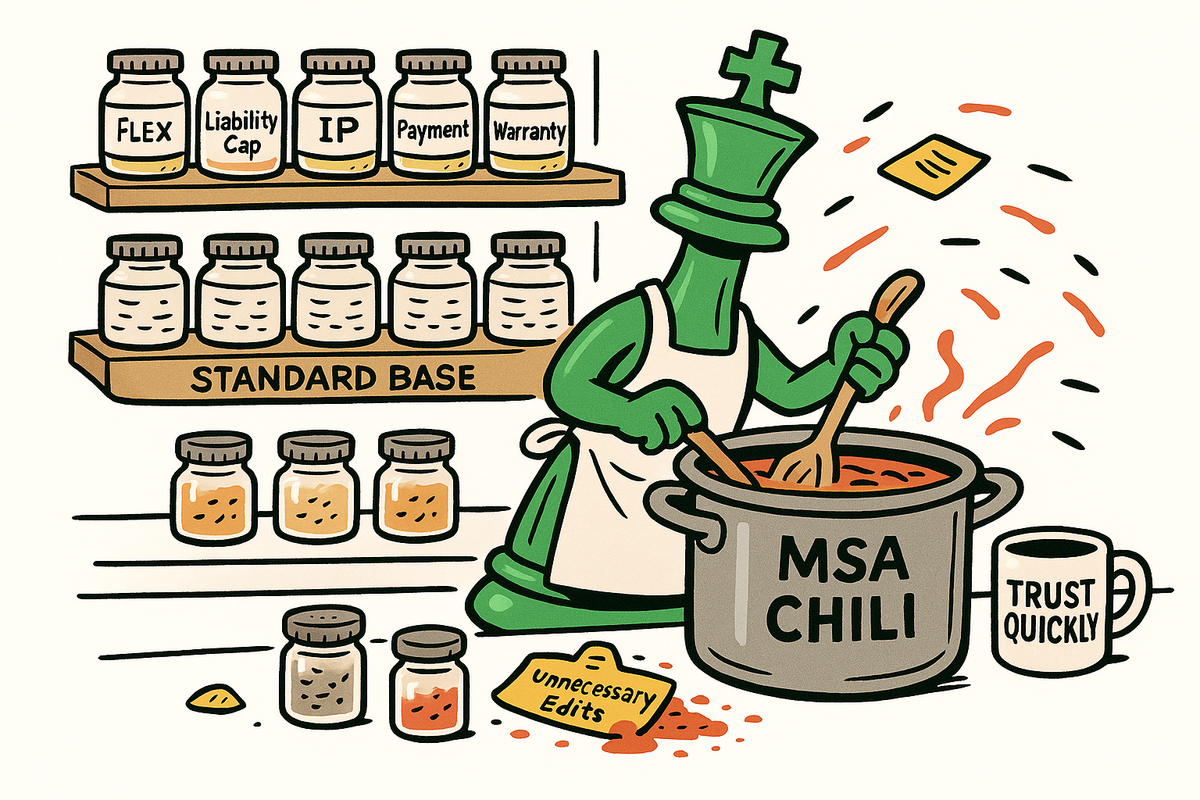
So let’s say you want to make chili. Cool—go grab your ingredients from our awesome pantry.
That pantry? That’s the universe of clauses that can be assembled into any kind of contract.
The chili? That’s your agreement... for example, a Master Services Agreement (MSA). It’s comprised of ingredients—of clauses.
A contract, at its core, is just a deliberate mix of clauses drawn from a massive pantry, selected for purpose, context, and flavor.
Change the core ingredients? You’re no longer making chili—now you’ve got beef bourguignon, or maybe a fettuccini alfredo. Same goes for contracts: change the mix of clauses and suddenly your MSA turns into a prenup or an asset purchase deal.
This is the first big insight seasoned practitioners carry in their heads (whether consciously or not):
Contracts aren’t magic. They’re recipes. Different deals call for different dishes. But every dish starts with a basic structure. It has a list of ingredients.
The Flex Zones
Now, here’s the twist.
While every chili has a common foundation (maybe tomatoes, onion, garlic, chili spices) there’s always a zone for experimentation. Beans or no beans (don’t get the Texans going). Spicy or mild. Ground beef or turkey.
Same thing happens in contracts.
Certain sections in certain agreements are almost always tweaked or negotiated. In an MSA, for example, you might find that there are different stances frequently taken on:
- Limitation on Liability
- Indemnification
- Warranties
- Payment terms
- Termination and renewal
- IP rights
In a prenup, they will be different areas. And in an employment agreement, other areas as well. These are your flex zones—the places where two parties typically may have some differences and have to align expectations, assign risk, and make tradeoffs.
They’re not random. They’re predictable. And, for the sake of discussion, let’s say they typically make up 30% or less of the agreement.
The rest? The 70% base layer? If you’ve done a bunch of deals, you know that it rarely changes. Sure, folks might use different synonyms or have their own particular writing idiosyncrasies, but the substance of this base layer is typically the same deal-to-deal.
It’s not that this base layer is unimportant—it’s just not where the energy belongs. But that’s not how most deals play out.
Instead, we get the scattershot markup, the full-document bloodbath, the 30-comment response to a three-page NDA.
Because the system doesn’t distinguish between base and flex. It treats everything as a potential battleground.
Here’s what that costs:
- Time: Every roundtrip over a “typically agreeable” term delays the deal.
- Trust: Excessive edits signal suspicion or posturing, not partnership.
- Momentum: When everything looks like a hill to die on, nothing gets prioritized.
And that’s the second big insight:
Most contracts have a finite list of “real” negotiable areas—and it’s smaller than you think. But we treat every clause like it’s equally negotiable.
What’s in the Fairway?
Every chili competition has judges—hell, even if you’re over at the neighbor’s grabbing a bowl, you’re going to be unconsciously determining whether the chili is “good”.
Even if preferences vary, there’s still a norm—a range of flavor, spice, and consistency that says, “Yeah, this belongs.”
Contracting’s the same. In every negotiation, practitioners are silently comparing the markup to an invisible standard:
- “Is this limitation of liability market?”
- “Are these indemnities aggressive?”
- “Do we usually see this much termination notice?”
The problem is, most of that comparison is subjective. But we have to do it if we’re judging risk in a contract.
We rely on anecdotal memory, gut feel, and war stories from prior deals. There’s no central scoreboard. No framework that says, “Here’s where 80% of deals land. Here’s the outlier territory.”
Which means:
- Some teams negotiate from outdated or outlier norms.
- Others shoot for “market” without knowing where the market actually is.
- Both sides lose time rediscovering what experienced practitioners already know.
- And you’re sure as hell not going to be agreeing out of the gate.
But that’s changing.
The future isn’t about less negotiation. It’s about anchoring that negotiation in objectivity.
That’s the third big insight:
There’s a “fairway” for most terms. We just haven’t made it visible. And it’s guiding your judgment whether you know it or not.
The Way Contracts Actually Get Reviewed
As the second installment of Wicked is dropping, let me give you a little peek behind the curtain, so-to-speak. Here’s what seasoned professionals are doing (whether they realize it or not) when they are either drafting an agreement or reviewing a markup:
- We make sure the pieces are in place (this is kind of a given... but we make sure this MSA is "actually" an MSA). Are the requisite clauses needed for an MSA present here? Is it structured like something I’ve seen before?
- We identify the flex zones. Where are the areas where I find myself negotiating time and time again? What are the areas where deals may differ based upon underlying factors such as price, size, etc.? What is typically negotiated (versus what is generally the same deal-to-deal)?
- We check or establish the flavors. How are these flex zones to be handled? Aggressively? Conservatively? How do they compare to what I typically see? How do they affect my risk? Do the economics justify the position? Does something else?
- We negotiate with intent. Focus on the areas that matter—the flex zones. If I push back, why? Is it preference, policy, or precedent?
This process isn’t mystical. It’s not about being a genius deal-whisperer. It’s pattern recognition. Experience. Muscle memory.
In fact, some folks get smart and document this process—you’ll find their output commonly referred to as a “playbook”. Identify the areas you care about. Consider your alternatives. Act accordingly.
For too long, we’ve left this knowledge locked in individuals rather than embedded in systems.
Which means:
- New lawyers fly blind.
- Small companies overcorrect.
- Big deals slow down while people reinvent the wheel.
That’s a huge part of the dysfunction.
The Role of Tools
Let’s be clear: tech isn’t going to negotiate the deal for you (though some proponents of GenAI may argue with that, and that’s a whole different discussion).
But what it can do—what it should do—is help surface these insights before you start editing:
- What kind of contract is this, really? Does it have the requisite components?
- What and where are the known “zones of negotiation” for this type?
- Where does this version fall with respect to the positions taken in these flexible areas? What are other positions on these areas that I can reasonably take?
That’s the power of structure. That’s the promise of transparency.
Not to dictate terms... but to clarify the terrain.
So both sides can walk in with eyes open and energy focused.
Wrapping it up
This diary isn’t about turning lawyers into line cooks. It’s about naming the process that already exists… and making it visible to everyone.
The best practitioners aren’t smarter. They’re just more intentional.
They know what to look for. They know where to focus. And they know how to separate seasoning from substance.
What if we gave everyone that ability—before they’ve logged a decade in the trenches? What if we turned experience into a system?
Hmmmmmm....
And to all of my US-based friends, have a safe and happy Thanksgiving!
Weigh in
What's your take on this? I'd love to hear your thoughts.
Join the discussion on LinkedIn