
Chaos Isn’t a Negotiation Strategy (Or: Why You’ll Never Align Without Structure)
Most negotiations aren’t strategic. They’re improvised—and everyone’s hoping to land in the same zip code.
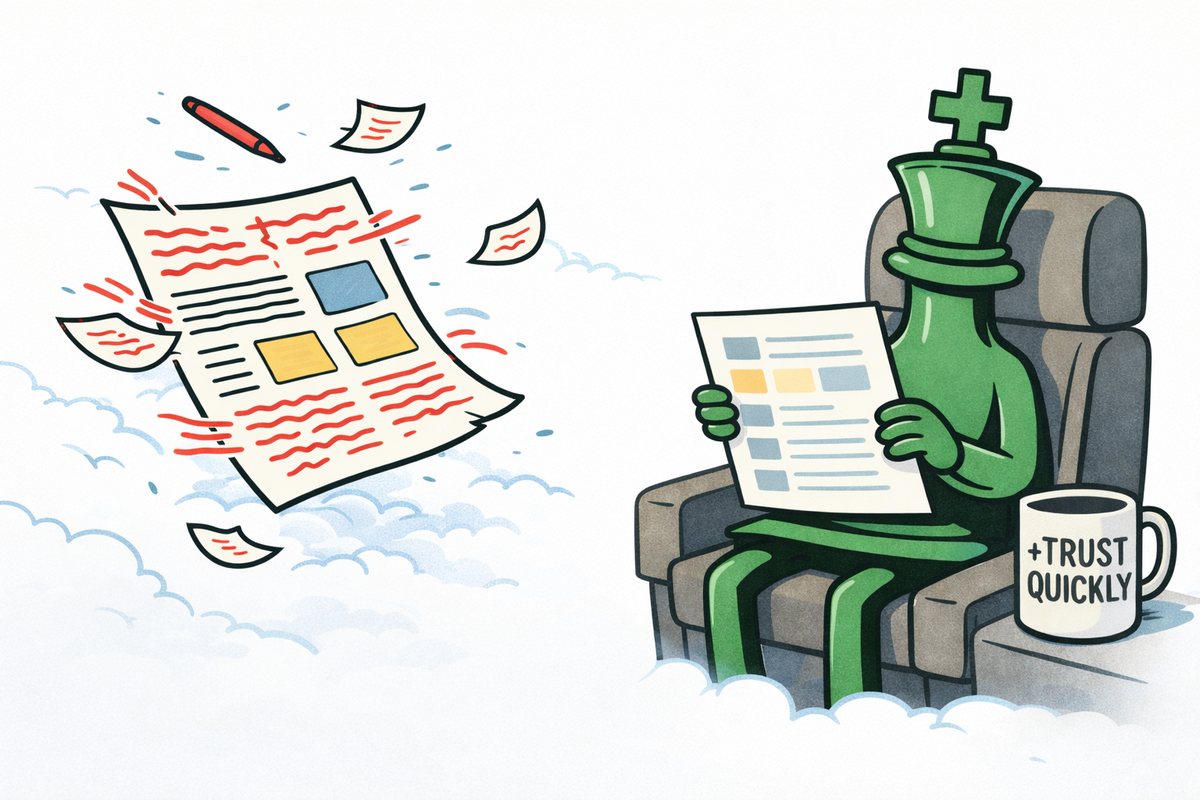
Redliner’s Log – Entry 2.4
Stardate: January 6, 2026
Location: Mid-flight over Negotiation Airspace. Debris fields from last markup pass still visible.
We like to think we’re being “strategic.” We say things like “let’s be thoughtful,” “let’s not rush,” “we want to be fair.” But when you peel back the layers, what most teams are doing during contract negotiations isn’t strategy. It’s improvisation.
We’re all flying blind—legal, business, founders, outside counsel—making it up as we go along and hoping to land in the same zip code. But when you don’t have structure, you don’t get alignment. And when you don’t have alignment, you don’t get deals.
Let’s talk about why.
The Myth of the “Smart Negotiator”
You’ve probably worked with one. Hell, maybe you are one. The person who can “read” the other side. Who claims to “feel out” a deal. Who talks about negotiation like it’s jazz... unstructured brilliance, solo improvisation, ego-driven artistry.
The truth? That might work once. Maybe twice. But it doesn’t scale. It doesn’t teach. And it doesn’t build trust.
Because what happens when the Smart Negotiator is out of office? Or too burned out to care? Or buried in seven other contracts?
The team flails. Deals stall. And your company bleeds credibility with every disjointed round trip of contract revisions.
Unstructured Collaboration Is Just Another Word for Chaos
Here’s what it looks like when structure is missing:
- Legal says one thing. Sales says another. Finance adds a last-minute condition.
- Outside counsel is redlining based on a doc they haven’t seen since last quarter.
- The business owner jumps in and rewrites half the agreement in plain English—which somehow contradicts the indemnity clause.
- The counterparty flags a “change” that was already in the template, and now everyone’s confused about who’s doing what.
- Version 4 turned into “Rob 22.23.25 Changes_1” turned into “Compare Rob to version 4.2” and no one knows which friggin' version is the current one.
- And of course, the “redlines on redlines” are starting to pile up, and you’re trying to figure out if that word is stricken, inserted, or both?
It’s not a negotiation. It’s a group project gone rogue.
Everyone’s working with different assumptions, different definitions of risk, and different visions of “acceptable.” And nobody’s wrong. They’re just not aligned.
The Real Cost of Chaos
This isn’t just a workflow problem. It’s an emotional and reputational one.
For the solo in-house lawyer: You’re already underwater. But now you’re fighting fires that shouldn’t exist, arguing over positions that should’ve been pre-aligned, clarifying things that should’ve been obvious.
For the SMB owner without in-house counsel: You’re bleeding hours and legal fees trying to figure out if the markup matters or not, all while your deal momentum slows and your budget takes a hit.
For both sides: Chaos breeds paranoia. And paranoia kills trust.
Every unexplained change, every unexplained delay... it doesn’t just slow down the deal. It casts doubt on the relationship.
Negotiation Needs Structure. Period.
Let’s define what I mean by structure.
I'm not talking about locking people into rigid scripts. I'm talking about building a shared framework that answers:
- What kind of contract is this?
- What are the standard components?
- Where do we usually see negotiation?
- What does “market” look like for each flex zone?
- What positions are acceptable vs. what’s a dealbreaker?
This isn’t theoretical. It’s how top legal teams already operate, but in their heads, in their inboxes, or in ad hoc templates.
I'm just saying: let’s make that system visible. Let’s codify it. Let’s stop making every team reinvent the wheel.
Structure Creates Speed.
When everyone knows where the real work is (and where it isn’t), they move faster.
No more arguing over formatting. No more wasted cycles on boilerplate. No more panicked calls about whether “industry standard” actually means anything.
It’s not that we avoid friction. It’s that we target it... to the places that matter. We get sharper. Smarter. More intentional.
And when that happens, deals don’t just move faster. They move with less pain.
There’s a saying in the U.S. Special Forces: “Slow is smooth. Smooth is fast.” Structure is kinda like that.
Structure Creates Safety.
Here’s a dirty little secret: most people in the deal process are afraid.
- Afraid of missing something.
- Afraid of getting blamed.
- Afraid of being the one who says “yes” to a clause that later blows up.
Structure changes that.
When your team knows what the fallback is… when the business owner knows what matters and what doesn’t… when your counterparty sees the same map you do… guess what?
You create psychological safety.
Not because risk disappears. Because expectations are aligned.
Structure Creates Trust.
If speed is the reward and safety is the protection, trust is the outcome.
Trust is what turns a redline into a collaboration. Trust is what gets your deal signed this week instead of next quarter. Trust is what gets the other side to tell you what they really need, not posture until the last minute.
And that kind of trust? It doesn’t come from charisma. It comes from clarity.
But here’s the part most teams miss: it’s not just about getting to signature. It’s about what happens after.
Because if you look at deals that actually work—the ones that don’t blow up six months later (or, as those of us of a certain vintage might say, those that stay in the desk drawer)—you’ll almost always find two things:
1. The parties were transparent. They had honest conversations. They skipped the posturing and got real about what mattered.
2. They understood the contract. Not just the general vibe, but the actual terms, the risks, the obligations, the edge cases.
That’s what sustains trust after the ink is dry. And that’s exactly what Transactency is built to deliver.
We don’t just help you negotiate. We help you understand what you’re agreeing to—and help your counterparty do the same. So you both walk away with eyes open, not crossed fingers.
This Is Why Transactency Exists
We didn’t build a legal tech platform to eliminate lawyers. We built it because even good lawyers are trapped in bad systems.
Our goal is simple: make structure the default. So founders, counsel, and counterparties walk in with the same map and get to “yes” without getting lost.
I’ll be back next week with Entry 2.5—a flashback to the kind of legal “strategy” that loses the deal before it starts. Because sometimes the problem isn’t the system; it’s the person who thinks they’ve already mastered it.
And from there, I'll start putting some shape around what actually works... the patterns, the playbooks, and the guardrails that make alignment possible.
Weigh in
What's your take on this? I'd love to hear your thoughts.
Join the discussion on LinkedIn
And check us out at Transactency for more info and to join our beta!